Monday, 6 February 2012

Siege warfare in Ancient Greece

In Mycenaean times siege warfare consisted of trying to break through gates with axes or rocks. The city walls were too tall and strong for the armies to break through with hand weapons.

Between 1000bc and 450bc the Greeks did not lay siege to cities because the defences were too strong and armies were made up of part-time soldiers who wanted to fight a battle and go home.

After about 450bc the Greeks began to learn siege tactics from their Persian enemies and to develop ideas of their own. At the same time some armies became made up of full-time soldiers, so lengthy sieges were more practicable.

The first tactic was to surround the city and so cut it off from any sources of food or supply. This usually called for a large army to keep a good watch for anyone trying to bring supplies to the city.

In 429bc a small Spartan army built a wall of brick and timber all the way around the city of Plataea to stop supplies getting into the city.

An assault ramp of earth packed between timber piles could be built against the city walls. This allowed troops to storm up and over the wall, but only if the defenders did not heighten it first.

A battering ram could be built of a bronze-tipped tree trunk suspended from a wooden cage on wheels. This could be pushed up to the city walls and swung repeatedly to smash a hole in them.

Defenders could counter a ram by shooting the men working it. Alternatively they could lower large hooks over the walls, catch hold of the ram and pull upwards to overturn it.

During Hellenistic times (see page 38) siege techniques advanced rapidly as the kings fought for control of the rich cities in what had been the Persian Empire.

Hellenistic siege engines included wooden towers 40 m high to allow attackers to attack the men on city walls, catapults able to throw stones that could destroy buildings, armoured wooden huts containing ballistae shooting giant bolts and a host of drilling and tunnelling devices.

from

1000 Facts - Ancient Greece by Rupert Matthews

Friday, 3 February 2012

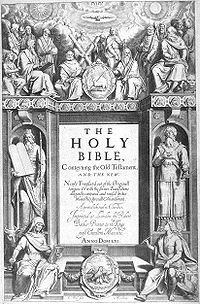
The Origins of the King James Bible

When James VI of Scotland became also King James I of England he was faced by religious difficulties. His answer was to continue the policies of Elizabeth I, but to take them forward by insisting that one version of the Bible and that alone could be used in England.


For some fifty years before James came to the throne, several different versions of the Bible had been circulating in England. These had been translated by various scholars from different originals and, although they were broadly in agreement, there were some key differences in wording which could cause confusion.

The religious divisions within England were less pronounced than in many nations, but were till severe. The Catholics had learnt to be generally content so long as they were left to pursue their religion in quiet, and the authorities were content so long as they were carried out in private. The more extreme Protestants, by now termed Puritans were more likely to be outspoken, but commanded little public sympathy.

James decided to continue with the religious policies of Elizabeth, but to enforce some of the laws more strictly so that those who chose not to worship at the Church of England found themselves subjected to fines more often. This disappointed both the Catholics who had hoped for more freedom and the Puritans who had hoped the new King would introduce a stricter Protestantism from Scotland.

After the failure of the Gunpowder plot, James and his chief minister, Robert Cecil began an even stricter attack on the Catholics. It was decided that a new English language Bible was needed to bind together the various Protestant factions. King James gathered together some of the finest scholars and most learned churchmen to complete the work. The team was ordered not just to produce an accurate Bible, but also one phrased in ways that were easily remembered so that even people who could not read very well could remember the key teachings of God.

When the Authorised King James Version was finally ready, it was printed in large numbers and sent to every church in the country. No other version of the Bible was permitted to be used in Church services and for centuries no other version was printed in the English language except the King James.

The move was as much due to King JAmes’s own deep religious convictions as to the political necessity of producing an agreed text. As the official foreword put it “For when Your Highness had once, out of deep judgement, apprehended how convenient it was that, out of the original sacred tongues, together with comparing the labours, both in our own and other foreign languages, of many worthy men who went before us, there should be one more exact translation of the holy Scriptures in the English tongue; Your Majesty did never desist to urge and to excite those to whom it was commended that the work might be hastened and that the business might be expedited in so decent a manner, as a matter o such importance might justly require.”

Once produced, the Authorised King James Bible became a standard work for the English. Many phrases form it have entered into everyday use and it has become the source of many sayings and phrases. It can safely be said that no other book in the English language has had such a profound influence as this version of the Bible.

Wednesday, 1 February 2012

The Mighty Melton Mowbray Pork Pie


What makes a British pork pie different from others?


Mention a pork pie to people from most countries and they will imagine any sort of pork baked into a pie, but to a Briton a pork pie means a very particular type of creation.


The British raised pork pie has its origins some centuries ago as a means of preserving the meat. Unlike salting and drying, the baking of pies was not intended to keep meat edible for some months, but merely to extend the time over which the flesh of a pig could be eaten after it was slaughtered. The key to the success of these pies was in the manner in which the crusts were formed.

The crust of a pork pie is made from hotwater pastry, a pastry made by boiling lard in a small amount of water before mixing it into the flour. The dough should be kneaded well and kept warm throughout. It is then capable of being moulded into shapes which will support their own weight. Traditionally pies are made by raising the pastry into a cylindrical shape with a firm base, usually by rolling out the pastry and then gradually raising it up the sides of a jam jar. The jar is removed when the pastry has reached the required height and is replaced with minced pork, with herbs to taste. The pie is then sealed with a lid made from the hotwater pastry. A hole is cut in the lid.

In past centuries, after the pie was baked, clarified butter was poured through the hole in the lid to completely fill the inside of the pie. The raised crust ensured that the butter stayed within the pie and did not run out. When solidified, the butter excluded the air from touching the meat and so ensured that it kept fresh for some time. As days passed the hotwater pastry did not turn stale as quickly as did other types of pastry, again aiding the storage life of the pies.

These days storage of meat is not the primary purpose of baking pork pies, so the rich butter is omitted from the recipes. However, the meat still shrinks as it cooks, leaving a distinct gap between the pastry and the meat filling. Modern recipes recommend the long, slow boiling of pork bones, onion and meat scraps to produce a rich stock which will set into a firm jelly. When the pie has been baked and allowed to cool, the stock is poured in and left to set solid.

As with so many British traditional dishes, each district of the country had its own way of preparing such dishes and nowhere became as famous for its pork pies as the town of Melton Mowbray. Located in the fertile farming lands of Leicestershire, Melton Mowbray has long been a wealthy and productive area. As testament to its agricultural wealth, the town has one of Britain’s most spectacular medieval churches which boasts not only a 100 foot tower and 154 foot length  but is also one of only four churches in England to have aisles to the transept.

In the hands of the bakers of Melton Mowbray, the pork pie achieved a height of succulence and tastiness not achieved elsewhere. The precise secret of the Melton Mowbray pie was not a single feature, but more a combination of features. The pork used was of the very best quality from nearby farms and was chosen for its low fat content. The pieces of meat were diced, not minced, and a blend of local herbs was used to add flavour. Taken together the combination made pies from this small town the best in England. These days shops throughout Britain sell ‘Melton Mowbray’ pork pies the vast majority of which have never been near the place. The label may be used only to indicate that the pie is of a superior quality to the standard pie from the same company. The best, however, still have diced meat and are highly flavoured with herbs.

Monday, 30 January 2012

The Permian Jungles

There was a major upheaval in prehistoric life around 270 million years ago
At the start of what scientists call the Permian Period, there was a rapid change in prehistoric life. A new type of animal evolved that rapidly became the most important form of life on Earth. These were the reptiles. They quickly took over many ways of life from the amphibians.


Early reptiles were well adapted to life on land
The first reptiles looked like amphibians, but they were different in several important ways. One of these was that their eggs were covered with a waterproof shell. Unlike amphibians, reptiles did not need to lay their eggs in water. They could therefore live far from streams and lakes.


Things to do
Edible Reptiles

You will need:
100gms dried milk
100gms smooth peanut butter
50gms honey
currants
food colouring

Mix the dried milk, peanut butter and honey together in a bowl.
Mould the “dough” into reptile shapes.
Decorate the dough reptiles with currants for eyes and colour with food colouring
With adult permission, scoff the reptiles for supper. Yummy!


From 100 Facts on Prehistoric Life by Rupert Matthews

Tuesday, 24 January 2012

The Outbreak of the US-Mexican War of 1847


The war of 1847-8 was the first time since the War of 1812 that the US armed forces had to face an enemy universally equipped with firearms and trained in European style warfare. The Mexican army was, however, poorly regarded and most Americans expected an easy victory.

The war had its origins in the 1836 conflict that brought independence to Texas and was famous for the siege of the Alamo. The Mexican government had never accepted Texan claims to the land between the Rio Grande and Rio Nueces. In 1845 Texas became a state of the USA, so the USA inherited the border dispute.

President Polk moved 3,500 regular soldiers under Zachery Taylor up to the Rio Nueces. He also sent John Slidell to Mexico City with an offer to pay $25 million dollars for the disputed land in Texas, plus the Mexican provinces of Alta California and Santa Fe. The Mexicans turned down Slidell’s offer in brusque terms, so the envoy returned to Washington in disgust.

In Texas, Taylor had built a small fort in the disputed territory. On 25 April 1846 the Mexicans ambushed a patrol of US cavalry in the disputed lands, killing 11 men and capturing the rest. Polk told Congress that the Mexicans had “shed American blood on American soil” and on 13 May war was declared.

Meanwhile, General Mariano Arista led 3,400 Mexicans to attack Taylor’s fort, prompting him to march his main force over the Nueces to relieve the surrounded men. The resulting Battle of Palo Alto was dominated by artillery. Taylor used a battery of horse artillery – light guns pulled by fast horses – to hammer the Mexican army, which then fell back into broken country where the horse artillery could not operate. The Mexicans opened fire with their own heavier guns, halting the American advance. Next day Arista retreated over the Rio Grande.

Meanwhile, in Alto California, local US settlers had taken matters into their own hands, declaring the province to be independent of Mexico. A force of 60 US soldiers under Captain John Fremont was diverted from Oregon to California to support the American settlers against the local Mexicans. The Americans won the climactic Battle of La Mesa on 9 January, after which the Mexicans retreated from California.

from THE ATLAS OF THE WORLD AT WAR  by Rupert Matthews

Monday, 23 January 2012

A nice Teashop in Herne Hill


Teashop:            The Woodrose Tea Rooms, Mount Ephraim, Staple  St, Hernhill, Kent  ME13 9TX
  Tel: 01227 751168

Distance:            3 miles

Map:                OS Explorer 149

Parking:            The teashop has a car park

Public Transport        Boughton Street is on Stagecoach bus route 3A from Canterbury. The teashop is about a 10 minute walk from the bus stop.

Conditions:            This walk is short but strenuous as it goes up and down steep hills that offer fine views.


1) Leave the teashop and return to Staplestreet Road. Turn right and head northwest. When you reach the Three Horseshoes pub turn right along Church Hill. As you enter the village of Hernhill you will find a church on your right.

The little village of Hernhill had one of the earlier churches in Kent, it was certainly here by about 750. That early structure was of wood and in 1120 was replaced by a stone and timber structure that was dedicated to St Stephen, as the first church may have been. In 1450 the church was demolished and replaced with the stone and flint building that is to be seen today. Unusually the dedication was changed to St Michael, though no reason for this is known.

The church is a fine example of Kent Perpendicular Gothic style and has a square tower with a ring of eight bells. The main door and door to the bell tower are 15th century, and the rood screen is 16th century. Much of the furniture dates from a restoration of the church in the 19th century, and a Lady Chapel was added in 1928 - though in a very sympathetic style that does not jar with the rest of the church.

2) Pass the church on your right then turn right down Crockham Lane. Ignore the first on the right and instead take the first on the left, a lane which cuts back uphill.

3) After about 300 yards the lane bends to the left. At this point take a footpath off to the right that climbs uphill toward woodland. In the woods, the path bends sharp left, then hooks right to complete a half circle and emerge on to a track. In the woods to the right stands a semi-derelict tower.

This is the Holly Hill Tower. It was built by the local landowner in the 1930s, apparently so that he could enjoy the views north toward the Thames Estuary and its ships. It has been abandoned since his death and is now rather run down. It is not open to the public, but is an interesting example of a very late example of a folly.

4) From the tower follow the track south until it emerges on to a lane. Turn right along this lane, Dawes Road, to a skewed crossroads junction. Go straight on along Dawes Road to a T-junction.

5) Turn right into Staplestreet Road and return to the tea rooms.

from

Friday, 13 January 2012

Driving to the Wye Crown, Kent

The Stour is the second largest river in Kent, draining most of the east of the county. In fact this is not one river, but three rivers that join to flow into the sea together near Sandwich. This drive follows the longest of the three rivers, the Great Stour. The Little Stour is about 9 miles long and the East Stour 10 miles long.

Ths drive starts just outside Lenham, named for the River Len which also rises nearby but which flows west to be a tributary of the Medway. Find the White Horse by leaving the A20 at Lenham and heading south out of the village on the lane to Leadingcross Green and Boughton Malherbe. The pub stands on the Sandway crossroads just after the lane crosses a railway and before it crosses the M20.

Leaving the pub drive north to the A20, then turn right toward Ashford. Just after the junction with the A252 the village of Charing will be to your left. Enter the village to find the church. This charming place appears to be more of a small town than a village. The ruins of what was once a palace owned by the Archbishops of Canterbury lie just outside and are worth a visit.

Return to the A20 and continue into Ashford. This was a relatively unimportant village until the railway was built through here in the 19th century. It was chosen to be a major repair and maintenance centre for the railways, and the little village grew rapidly to become a town. The East Stour flows into the Great Stour just south of Ashford. At Ashford turn northeast along the A28 toward Canterbury.

About three miles outside Ashford turn right along a lane leading to Wye. This village has houses that date mostly to the Georgian period. For some reason the local builders chose to include grotesque heads and figures on many of the houses. It is a pleasant enough place, and the church is worth a look, but the real attraction lies along the lane east of the village to Hastingleigh. The hill above the lane is dominated by a huge white crown about 180 feet tall. The hill figure was formed by hacking through the green turf to reveal the white chalk underneath.

From TEASHOP DRIVES IN KENT by Rupert Matthews